Private Label Lip Gloss: Formulating for Finish and Wear
A gloss is judged on the lip, not on the swatch, and the judge is shine, transfer and how it feels on reapplication. Colour is only one input. The client's lip gloss page cites Euromonitor data putting the global lip glaze market at $18.5 billion in 2024 with annual growth over 14%, and it supports matte, mirror and velvet finishes from a library of 10,000+ mature formulas.
Key takeaways
- Finish is the first thing a customer notices, before the shade.
- Customisation covers matte, mirror and velvet effects with 1:1 colour-number restoration.
- Order floors usually fall between 1,000 and 5,000 units per product, and a startup entry can be as low as 500 units.
- The client's page cites Euromonitor for a $18.5 billion lip glaze market in 2024 growing over 14% a year.
Gloss is judged on finish, not colour alone
Two glosses can match the same shade number and still read as different products. One looks wet and glassy, the other soft and blurred, and a customer picks between them in seconds. That quick read comes from the base and the oil phase, not the pigment, which is why finish has to be chosen as early as the shade.
Wear follows the same logic. A high-shine film tends to move and transfer, while a cushioned velvet film holds longer but feels heavier. The brand has to decide which property it is willing to trade, because a formula that promises maximum shine and maximum hold usually ends up average at both.
Three finishes and what each one asks of the formula
Matte reads as a smooth, low-shine stain and needs the pigment to sit evenly without the oil phase pooling. Mirror pushes the shine to a wet, reflective level and depends on a clear film that stays level as it settles. Velvet sits between the two, softening the edges while keeping a cushion under the lip, and it is the finish most first ranges choose.
Yunmei's pages describe colour customisation that covers matte, mirror and velvet effects and supports 1:1 colour-number restoration. That range means a brand can test one shade across three finishes before committing, which is the fastest way to learn what its own customers actually reach for.
Transfer, wear and reapplication
Transfer is the complaint that drives returns. A gloss that marks a cup five minutes after application reads as low quality even if the colour is right. Managing it usually means tuning the film former and the oil phase together, and then checking the result on a real lip rather than on paper, where every gloss looks stable.
Reapplication is the second half of wear. A feather-light mirror gloss may need topping up every hour, while a heavier velvet holds longer but asks the customer to accept the weight. Neither is wrong, but the pack copy and the marketing promise should match the formula the buyer approves. A simple wear diary, written over a normal day of eating and drinking, tells the formulator more than a laboratory panel, and it costs nothing but a week.
Shade matching and colour-number restoration
Shade matching for gloss is a brightness problem as much as a hue problem. Because the film is translucent, the base colour of the lip shows through and changes how the shade reads. A reference matched on an arm swatch can look a half step lighter on the lip, which is why approval should happen on a worn sample.
The published 1:1 colour-number restoration is useful here. It means a reference shade can be reproduced rather than approximated, so a brand can carry one identity across finishes without re-approving the colour from scratch. The supporting work on finishes sits under the same private label lip gloss programme.
| Finish | Look on the lip | Wear note |
|---|---|---|
| Matte | Smooth, low shine | Even pigment, minimal pool |
| Mirror | Wet and reflective | High shine, moves more |
| Velvet | Soft and cushioned | Holds longer, feels heavier |
Worked example: reading the order minimum chart
The chart shows three published order minimums in units. At the startup entry, 500 units is 500 ÷ 1,000 = 0.5, or half the 1,000-unit low end of the usual band, and 500 ÷ 5,000 = 0.1, or one tenth of the 5,000-unit high end. The band itself spans 5,000 - 1,000 = 4,000 units. For a six-shade launch the entry level costs 6 × 500 = 3,000 units, the low band 6 × 1,000 = 6,000, and the high band 6 × 5,000 = 30,000.
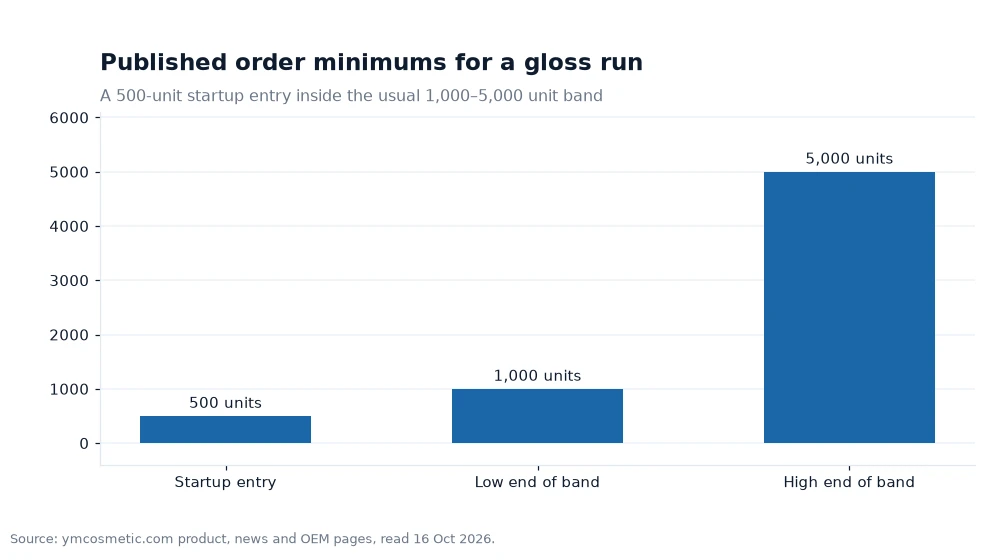
The two numbers to hold on to are 500 and 5,000, a ten-fold spread. The 500-unit entry lets a new brand test a single shade with real fill equipment, while the 5,000-unit ceiling is where a fuller range starts to make sense on cost per unit. A six-shade launch can sit at either end, so the plan should follow cash rather than habit.
Where the market is heading
The client's lip gloss page cites Euromonitor data that places the global lip glaze market at $18.5 billion in 2024, with annual growth over 14%. Growth at that pace usually pulls more brands toward the category, which raises the value of a formula library and a finish range rather than a single hero shade.
It also shifts the competition toward texture. When the market is expanding, a brand that only copies a popular shade competes on price, while one that owns a finish customers recognise competes on preference. The formula work is what makes the second position possible. It also rewards brands that stay close to one or two finishes instead of spreading across every effect at once.
Planning the first gloss run
Decide the finish first, then the shade count, then the total units. Those three choices set the order size, the sample rounds and the pack. Testing one shade across two finishes early is cheaper than committing a full range to a finish that turns out to be hard to fill or hard to sell.
From there, keep the wear story honest. If the formula trades hold for shine, the copy should say so, because a customer who knows what to expect is less likely to blame the product. Testing both finishes on one shade also tells you, before a bulk order, whether the OEM/ODM line can hold the film you approved. The wider makeup manufacturing range shows where gloss sits beside the other categories a brand can add later.
Frequently asked questions
Which finishes can be customised?
The client's pages describe matte, mirror and velvet effects, with colour customisation that supports 1:1 colour-number restoration so a reference shade can be carried across finishes.
What is the smallest order for a gloss run?
The published band is typically 1,000 to 5,000 units per product, with a 500-unit startup entry. A 500-unit entry is half the 1,000-unit low end and one tenth of the 5,000-unit high end.
Is the lip glaze market still growing?
The client's lip gloss page cites Euromonitor data putting the global lip glaze market at $18.5 billion in 2024 with annual growth over 14%, which is why finish and texture matter as much as shade.
Choosing the finish for your range
Finish is the fastest way to give a new gloss range a clear identity, and it is also the decision that shapes wear, refill size and cost. Settle it before the shade count, and the rest of the brief falls into place. A practical first step is to request the same reference shade in two finishes, then wear both for a day before you choose. More of that work sits on the lipstick programme for brands building a fuller lip line.
Order bands, testing windows and factory data were read from the company's website on 16 Oct 2026.[1]